Showing posts with label and. Show all posts
Friday, March 7, 2014
Arizona Pool Builder And Architectural Landscape Designer Bianchi On Outdoor Living As An Artform
Thursday, March 6, 2014
Designing With Plants Shape and Form

Designing with Plants using their shape or form can be an excellent way of creating structured and interesting focal points within a landscape and garden design. Some Plants have naturally interesting shapes with interesting leave patterns. Others can be pruned creating simple to interesting shapes, to contrast against adjacent wild and sprawling varieties.
Natural Shape and Form (Sculptural)
Sculptural Plants with naturally interesting and striking shapes can be best used as focal points within a garden design when used adjacent ordinary groundcovers and shrubs. Sculptural Plants can also have impressive impact within a landscape design when planted on mass over an area. The repetition of the sculptural Plants striking form can provide a strong geometric and structured design to a space. Some layout ideas are as follows: For a strong geometric pattern, plant at regular intervals based off the spread(diameter) from the centre of each plant. Keep Plants aligned as straight as possible. For a more naturalistic appearance plant in clumps spaced at similar spaces as above but this can vary. To use sculptural Plants as focal points, the use of singular specimens on their own in a smaller garden will be adequately effective but occasionally in a large garden or landscape they can fade into the background too much. To reduce this problem just minimise other planting surrounding it or add a few more so the focal point ends up being a clump.
Some examples of sculptural species are as follows:
Macrozamia communis - Burrawang
Lepidozamia peroffskyana - Scaly or pineapple zamia
Cycas revoluta - Sago Palm
Asplenium nidus - Birds Nest Fern
Doryanthes excelsa - Gymea Lily
Dicksonia antarctica - Soft Tree Fern
Xanthorrhoea spp - Grass Tree
Prune to create form
Pruning shrubs, groundcovers or even trees to shape is another option to create a feature or style a garden.
Plants should be chosen that can be shaped, hedged into simple forms that can create contrast within the garden design. Many Plants can be shaped including some Australian Native Plants. A small list of Plants has been provided below. Designing a garden where Plants are to be regularly pruned to maintain form will require a successful maintenance regime. The Plants will require pruning from early on, to start shaping and improve foliage cover over the plant. If early pruning is avoided some shrubs can become open and woody which is undesirable. There are many ways of using pruned Plants within a garden design. There is the typical formal clipped hedge garden where basically everything is clipped apart from possibly the groundcovers. Then there is the more wild and sprawling planting style with regularly clipped feature Plants formed up in shapes as focal points in the landscape design.
Some good Plants for shaping are:
Buxus microphylla - Japanese Box (Dense growing, prune to shape)
Westringia species - (Native - prune regularly as it can become woody)
Murraya paniculata - Orange Jessimine (fairly forgiving for forgetful gardeners)
Syzygium spp - Lilly Pilly (Native - Good hedging plant)
Trachelospermum jasminoides - Star Jasmine (can be grown as a climber and clipped and also as a low hedge, fast grower)
Dietes iridioides (Grass style plant - can be clipped into a ball)
Lomandra species (Native - Grass style plant - can be clipped into a ball)
Photinia species (good hedging plant)
Michellia figo (good hedging plant)
Callistemon species (Native - prune after flowering as it can become woody)
Melaleuca species (Native - prune after flowering as it can become woody)
Monday, March 3, 2014
Wild Windy and Wet with a dash of Wisdom
Most of my friends think we are barking mad - and Im not sure about the less friendly, but it is true that camping in the almost guaranteed rain of our West Country is not everyones idea of a perfect holiday. However that is precisely what my husband and children like to do best, so I follow along each year, getting slightly better at making pancakes in the rain, and charting the location of every local swimming pool with military precision to allow a seemingly opportunistic visit to the shower to tie into each days outing.
The base for our wild and windy wet week is always my husbands uncles farm in Devon, at the end of a creek which leads to the sea. On a really wet year when the sea came up to meet our tents, and I worried about my double mattress being washed away (a girl needs one luxury..) my husband was over joyed, as he was able to canoe the whole way down to the sea with my son, as he had every year as a boy.
My husbands uncle is an extraordinary man, and I would like to tell you about him.
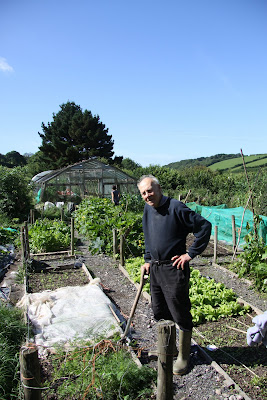
He grew up in Trinidad, the son of a wealthy sugar grower, and came back to farm on Church Commission land in Devon as a young adult. The Church said a farmer needs a woman, so my mother-in-law moved in as temporary land girl until a lovely wife was found.
With a non stop enquiring mind John tried all the best methods of farming, which in the fifties and sixties meant all the best chemicals. Gradually he became disenchanted with the divorce between land and husbandry, and began to look into an unusual practice then, called Organic Farming. He started with pigs and a dairy herd. He has left a legacy to his children of one of the best known organic farms in the UK. Riverford Farm now has country wide franchises that send organic boxes (run by son Guy) that include vegetables, milk (run by son Oliver) and meat (cue son Ben) to doorsteps all over England. Marketing is by daughter Rachel and young stock are brought up by daughter Louise.

Time to retire you may think, but John is determined to make this planet a better place, and to that end is experimenting with several types of renewable energy. He has a wind turbine in his orchard, a water wheel in the stream and last year was experimenting with a rather dodgy looking methane gas collecting pit - I had visions of us all going out with a bang in the night.. This year he has invested in a huge swathe of solar panels on his barn roof, and had been experimenting with rendering cattle bones in vats to see how much energy could be produced - this on behalf of some university or other. I was just quite glad hed finished boiling bones by the time we arrived. He aims to live a carbon neutral life, and survives on a tiny amount of electricity and fuel year. The only time I have seen this kind and smiling man annoyed was a few years ago when one of my children went to the loo in the night, and left the light on..
At 80+ he runs a local organic vegetable gardening cooperative around these polytunnels, with a fabulous crop of veg, all lovingly tended under their half-plastic-bottle cloches and tied up with carefully reclaimed string.


The children were intrigued to hear that this year we were sharing our orchard with a couple of Woofers.
But no cuddly dogs in sight - John had installed a caravan in order to host two intrepid part time workers participating in World Wide Opportunities in Organic Farms, working and learning their way around the UK as they look for a smallholding of their own.


As we left John was preparing to harvest his apples. He was collecting hundreds of recycled bottles to wash and fill with home made apple juice to be made during a bring-your-own apple pressing day he runs locally. All proceeds go to Oxfam. Which as you may tell from the top photo John also supports by buying his clothes.
I think he deserves a knighthood - but its my guess that Buckingham Palace would be too far in fuel for the carbon footprint to allow.
Read More..
The base for our wild and windy wet week is always my husbands uncles farm in Devon, at the end of a creek which leads to the sea. On a really wet year when the sea came up to meet our tents, and I worried about my double mattress being washed away (a girl needs one luxury..) my husband was over joyed, as he was able to canoe the whole way down to the sea with my son, as he had every year as a boy.
My husbands uncle is an extraordinary man, and I would like to tell you about him.
He grew up in Trinidad, the son of a wealthy sugar grower, and came back to farm on Church Commission land in Devon as a young adult. The Church said a farmer needs a woman, so my mother-in-law moved in as temporary land girl until a lovely wife was found.
With a non stop enquiring mind John tried all the best methods of farming, which in the fifties and sixties meant all the best chemicals. Gradually he became disenchanted with the divorce between land and husbandry, and began to look into an unusual practice then, called Organic Farming. He started with pigs and a dairy herd. He has left a legacy to his children of one of the best known organic farms in the UK. Riverford Farm now has country wide franchises that send organic boxes (run by son Guy) that include vegetables, milk (run by son Oliver) and meat (cue son Ben) to doorsteps all over England. Marketing is by daughter Rachel and young stock are brought up by daughter Louise.
Time to retire you may think, but John is determined to make this planet a better place, and to that end is experimenting with several types of renewable energy. He has a wind turbine in his orchard, a water wheel in the stream and last year was experimenting with a rather dodgy looking methane gas collecting pit - I had visions of us all going out with a bang in the night.. This year he has invested in a huge swathe of solar panels on his barn roof, and had been experimenting with rendering cattle bones in vats to see how much energy could be produced - this on behalf of some university or other. I was just quite glad hed finished boiling bones by the time we arrived. He aims to live a carbon neutral life, and survives on a tiny amount of electricity and fuel year. The only time I have seen this kind and smiling man annoyed was a few years ago when one of my children went to the loo in the night, and left the light on..
At 80+ he runs a local organic vegetable gardening cooperative around these polytunnels, with a fabulous crop of veg, all lovingly tended under their half-plastic-bottle cloches and tied up with carefully reclaimed string.
The children were intrigued to hear that this year we were sharing our orchard with a couple of Woofers.
But no cuddly dogs in sight - John had installed a caravan in order to host two intrepid part time workers participating in World Wide Opportunities in Organic Farms, working and learning their way around the UK as they look for a smallholding of their own.
As we left John was preparing to harvest his apples. He was collecting hundreds of recycled bottles to wash and fill with home made apple juice to be made during a bring-your-own apple pressing day he runs locally. All proceeds go to Oxfam. Which as you may tell from the top photo John also supports by buying his clothes.
I think he deserves a knighthood - but its my guess that Buckingham Palace would be too far in fuel for the carbon footprint to allow.
Subscribe to:
Comments (Atom)